Need Quick Response? Call us +61 1300 909 339

Australia has long attracted refugees and asylum seekers. Many turn to this country to escape violence and persecution in their homeland. Australia’s immigration policies have evolved continuously to satisfy border security and safety issues while accommodating humanitarian needs.
Refugees may receive temporary protection through a Temporary Protection Visa (TPV) and a Safe Haven Enterprise Visa (SHEV). This article explains the meaning of these visa types and how they differ from the Permanent Protection Visa (Subclass 866) and from each other.

Individuals holding a Temporary Protection Visa (TPV) receive protection for a period of 3 years. TPVs are available to asylum seekers if they prove they are eligible for protection under Australia’s international protection obligations, namely, under the 1951 Refugee Convention. The following are the eligibility criteria for obtaining a Temporary Protection Visa (TPV):
- The individual must meet the refugee requirements under Australian law.
- They must have arrived in Australia without a valid visa.
- Before further processing, they must clear security, identity, health, and character checks.
- They can work and study in Australia. However, they do not receive the support permanent visa holders are eligible for, such as social security payments, higher education loans, etc.e individual must meet the refugee requirements under Australian law.
Typically, they are not allowed to travel overseas without written permission. TPV holders’ access to government services is limited compared to permanent residents or citizens. Individuals holding a TPV must operate within the following restrictions:

The Safe Haven Enterprise Visa (SHEV) was established in 2014. Issued to refugees, this visa encourages them to live and work in regional Australia. Unlike TPV, this 5-year visa may enable individuals to seek permanent residency upon meeting specific criteria. The following are the basic eligibility criteria for obtaining a Safe Haven Enterprise Visa (SHEV)
Like TPV holders, SHEV holders have limited access to healthcare facilities. They cannot sponsor family members to have their families join them in Australia.
SHEV holders must work or study in regional areas in Australia for at least 42 months during their visa period.
If they meet the work/study criterion for the given period, they might be allowed to apply for specific skilled or family visas. Hence, SHEV offers a pathway to permanency. However, Permanent Residency (PR) is not guaranteed.

The Temporary Protection Visa (TPV) and the Safe Haven Enterprise Visa (SHEV) offer temporary protection to people who arrive in the country without a valid visa. These individuals enter Australia seeking asylum or as refugees. These visa types are of a temporary nature and differ from the Permanent Protection Visa (Subclass 866).
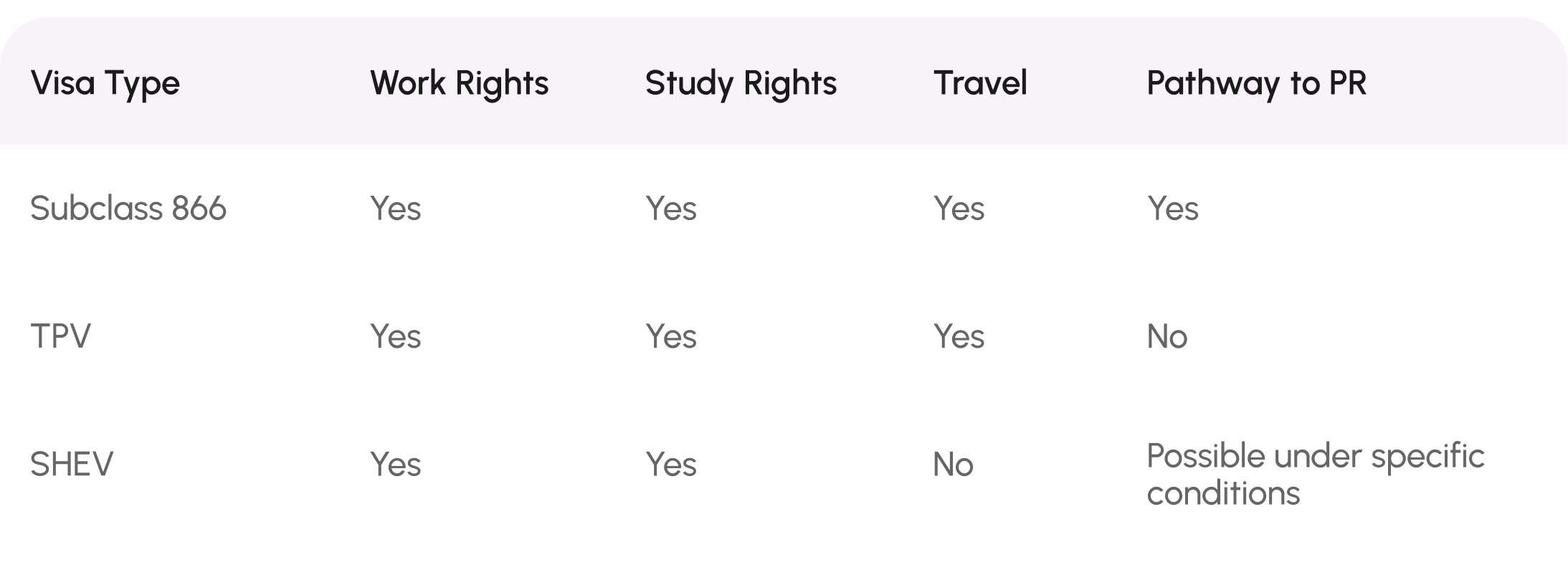
The Permanent Protection Visa (Subclass 866) is issued to refugees who have entered Australia legally and have been granted refugee status. They have access to Centrelink and Medicare benefits. The following table outlines the key differences:

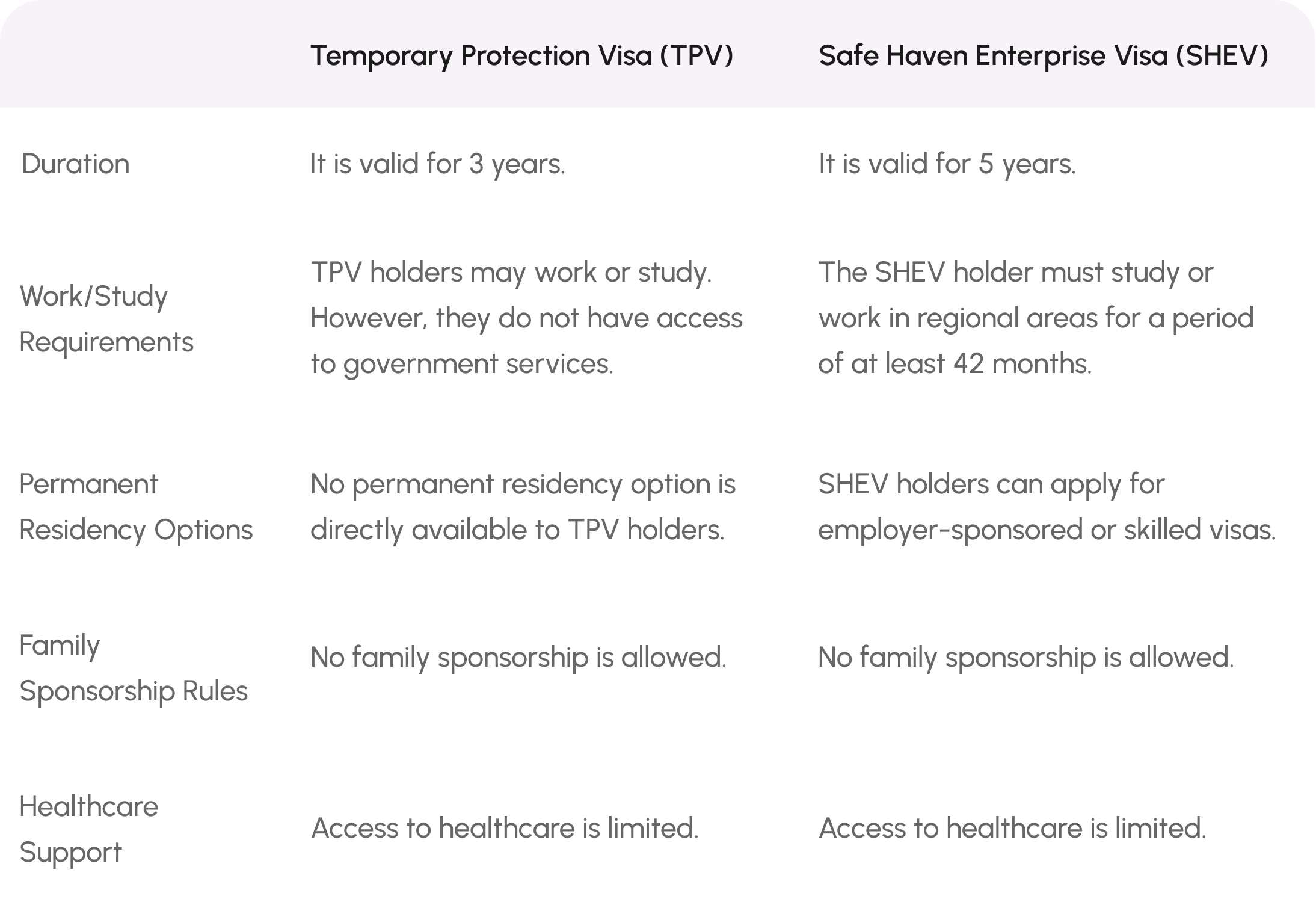
The section below highlights the distinctions between TPV and SHEV.
As Australia’s immigration policies change, changes in TPV and SHEV guidelines are possible. There have been discussions surrounding the dissolution of TPV and SHEV visa options. The Resolution of Status (RoS) visa is a feasible alternative to these visas. The RoS can make it easier for refugees and asylum seekers to remain in Australia for a more stable and extended period.
The RoS visa enables TPV and SHEV holders who arrived in Australia before 14 February 2023 to apply for RoS and gain access to government services. TPV and SHEV holders must apply for RoS before their respective visas expire. Upon receiving the RoS visa, such individuals will be allowed to live, work, and study in Australia for long periods. They will also have access to Medicare benefits and Centrelink payments.
Moreover, they can sponsor family members and facilitate reunification.

The RoS visa holders can also access short-term counselling for torture and trauma if needed. Furthermore, these visa holders can become Australian citizens if they meet specific eligibility criteria.
The Temporary Protection Visa (TPV) and Safe Haven Enterprise Visa (SHEV) are crucial to Australia’s immigration and refugee policies. Though they offer limited access to government services within Australia, they allow refugees and asylum seekers to escape persecution in their home countries.
As Australia balances humanitarian obligations with national security, reforms may be needed to ensure the government can provide long-term solutions to refugees and asylum seekers. The Resolution of Status (RoS) visa may help streamline the challenges associated with immigration, citizenship, and refugee protection in Australia.
Applying for a protection visa out of fear of political persecution can be quite stressful and overwhelming. At Protection Visa Australia, we understand the challenges individuals face when seeking protection. We offer comprehensive migration services personalized to your circumstances.
As an experienced team of migration agents, we can handle everything from documentation and evidence collection to appeals and reviews if needed. Therefore, you can call us to schedule a consultation with professionals who can assist with your application.